
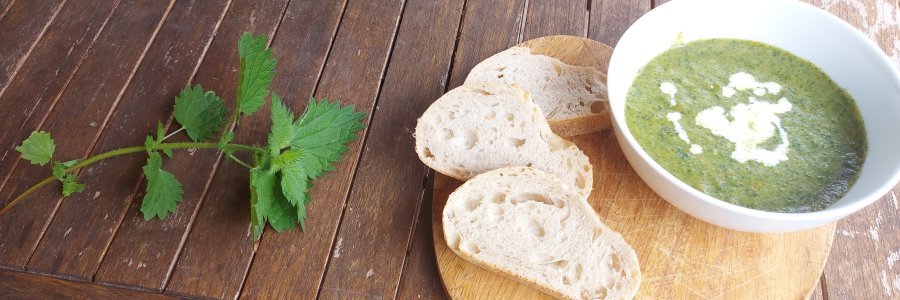
This recipe has evolved, blending suggestions from professional books and recipes from family and friends; we have practiced it in indoor and outdoor scenarios, and enjoy how adaptable it is, with complete freedom of ingredients lists! Another great showcase for nettles - our favourite foraged resource.
Being based on a rustic-style "pottage" there is no need to define ingredient portions accurately, so it works well in an off-grid kitchen with limited tooling, and you are free to explore (as we'd encourage with everything!). We also feel that nettle soup is a truly wholesome meal, which you actually feel is doing you good whilst you eat it - check our blog on nettles for more about the plant and its uses.
Preparation
When gathering nettles, they have the best texture and nutrient combination for eating when young, so are best collected from short plants (knee height or lower is often stated as a mark) or taken from the top of taller stems, especially if you're also making cordage. Bear in mind the type of environment you are foraging from and particularly what other animals might be around (don't gather low down around urban paths!). Collect wearing protective gloves, but gently "nipping" the top 10-20cm of the stem - it's not stringy in this top part, and therefore good as a pot vegetable. Following the guidance from River Cottage's Hugh Fearnley Whittingstall, you need a decent carrier bag full (ideally), but again we've found quantity can be varied to suit tastes.
We note for full-disclosure that whilst this is essentially a vegetarian recipe (and can be vegan and gluten free, depending on ingredients), there is a chance with all foraged ingredients that some stray insects may be hiding amongst your freshly collected leaves. If you're concerned, you can wash the nettles before cooking, in a clear stream or pot of water.
Preparation requires only a large pot with lid, knife, spatula/scoop, and stable chopping surface.
Cooking requires any heat source, including camp fire, and requires a steady heat to achieve a simmer (adjust your campfire embers accordingly).
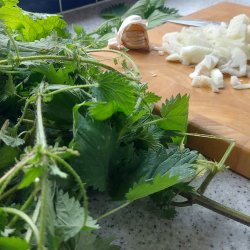
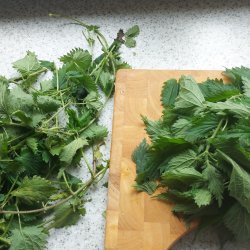
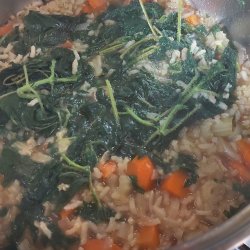
Rough-cut ingredients. Selected nettle tops. Rustic pottage, or blend for a soup.
Main Recipe
BASE
- slice a decent sized onion (cubes, slices, whatver you feel like)
- add olive oil to a large pan and start heating
- crush a few cloves of garlic (under a large knife, or slate)
- add some ground black pepper or whole peppercorns
- pop the lid on and heat steadily this until the onion is soft, stir occasionally
this will simmer for about 10mins, so you have time to stoke the campfire and prepare other ingredients
ADDITIONS
- add sliced or diced carrot if available/wanted
- add sliced or diced celery if available/wanted
- add something starchy to provide a base - 1-2 medium diced potato (1 jacket sized, or a few new) or 1-2 handfuls of arborio rice are good; a couple of rice-cakes can also be used
- pop the lid on again, and leave for another 5-10mins, then stir again
by this point it will need more liquid, to stop ingredients charring
- add about a pint of stock - we recommend a Kallo vegetable stock cube, but anything could be used; ideally vegetable based, to avoid a clash of flavours (PREP NOTE - If you are cooking around a campfire, it would help to have a kettle of boiling water ready, but you can add cold water plus a stock cube and bring it back to heat; it doesn't seem to affect the soup flavour much!)
leave this to simmer gently with the lid on, stirring occasionally, whilst you prep the nettles
NETTLES
you are perfectly at liberty to be selective, in order to achieve the best texture, flavour and health benefit! wearing hardwearing gloves for protection against stings, check through your gathered leaves and stems again, and pinch off and discard any stems more than about 4mm thick or leaves that look tough or "tired".
After sorting, you should have a bundle that can be scooped with two hands (about the size of your head), and a refreshing aroma in your kitchen workspace.
- stir the existing ingredients, then add all the nettles into your pot.
- add another pint of (ideally hot) water, then put the lid on again.
- simmer for another 20mins (or more if required), strirring occasionally.
Serving and Close
Once the nettles are fully softened, the soup/pottage is ready to eat when ready. It can be served immediately (scooped scooped with a mug), or blended with a stick blender (battery powered off grid) or hand-pull blender (per portion), or left to simmer for more blended flavours.
Soured or fresh cream or yoghurt is good to add on top, and some rustic bread (possibly baked fire-side!).
If you have left-overs, the soup can be absolutely be eaten cold later (within a few days) or frozen.
Do let us know your results and any recommended adaptation - it is an ancient dish which benefits from individual variations. For example, this has minimal seasoning, but nutmeg or chilli can both be added for a different result.
And if you don't have a spatula, why not contact us about a wood-crafting course and make your own from a fresh log! :)