
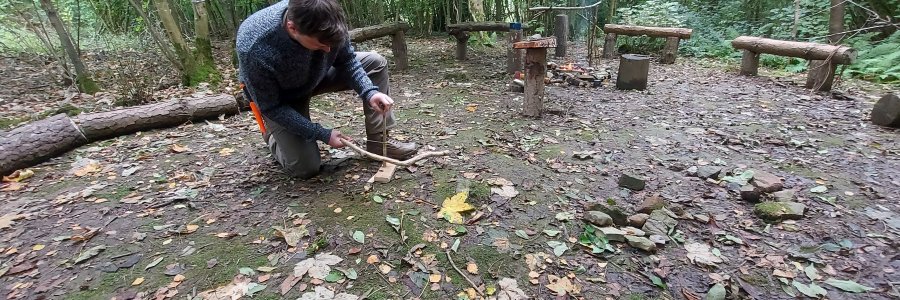
When I was younger, I was part of the cadets and found myself drawn to fieldcraft. Whenever we could, we got outdoors and into the fields, to learn radio codes, hand signals, how to track bootprints and how to generally keep yourself in good condition a long way from home.
My experiences taught me teamwork, communication, self-reliance and made me confident in my physical and mental fortitude. It was these skills that pushed me back to explore the outdoors and survivalism, booking an immersive, introductory training course with Trex Explore Ltd in Gloucestershire and getting back into outdoor life with as much energy as I could.
Bushcraft Immersion Course
Before we had even started I was encouraged to provide direction to activities, being asked which parts of the course I would like to focus on, areas that I wanted to explore or improve in. I found this liberating and encouraging, as it gave me an element of control over the days learning. I picked tree and plant identification, as they underpin so much of other outdoor craftsmanship, but was also an area that I had almost no prior experience in.
As we headed along the trail to the firecircle, I realised we were learning and being shown how to identify the trees and plants along the route, their appearances, utility and place in folklore.
At the same time I was told that we were looking for material to build our shelter with and dry kindling for the fire; fallen branches to set out the structure of an “A-Frame” were easy enough, and a short walk led us to thickets of bracken that we used to coat the structure. Being careful to take from a wide area and avoid depleting them.
As the day’s skills guidance and practice progressed, I began to think more about how my fieldcraft training had differed from what I was now being taught, and I felt even more invested than I had been as a cadet, yet also more at ease at the same time. This was a profound realisation for me, and unexpected. The skills and knowledge are less about having things ready-made, and more about being ready to identify and adapt. I had to rapidly unlearn several lessons from that time: my reliance on kit and procedure had earlier made me skittish, before the course – for the day off-grid and overnight camp, I had expected a long kit-list to rely on, but instead, I had to rely on trust, instinct, and relax!
Reflections
I think that the differences between the skills and mentality between the two schools (of cadets and bushcraft) can be summed up with a single topic, I learned on my bushcraft course: Cordage!
If you’re on a military-focussed fieldcraft expedition and you’re having to make your own string, then something has gone seriously wrong, you are missing something essential to your survival. Yet in bushcraft competency, it’s a technical craft and an indicator of mindset – it is trickier than expected, and time-consuming, but ultimately demonstrates confidence in being ready for anything.
Bushcraft competence requires dedication to learn and a humble self-reliance; your ability to pause, reflect and take time to try are vital. There are no exact, measurable methods and metrics, and found freedom in the lack of any kind of judgement!
I learned that there are skills and criteria for assessing bushcraft (international and national events, training courses, assessments and so on.), but it is ultimately about how willing you are to persist, to build your own confidence in your skills and knowledge and learn about the environment you are in.
I am glad that I joined the full immersive 2-day course, with overnight camp around the firepit; it met my eagerness to get back to outdoor living and gave me a chance to reflect on my own approach and pre-conceptions. I moved beyond cadets training, relearned how to recognise and use the materials that surround me.
Morgan, October 2024